

Ep. 3: We're In The Shit Business

People have made money cleaning up shit since the Medieval Age. Back then, city residents dumped their shit into open gutters on the street. The modern corporation had not been invented yet and capital markets were still yet to be imagined, but city authorities and wealthy families were already starting to direct financial resources to cleaning shit up.
The names of the earliest waste management jobs varied across cultures around the world. People were employed as “night soil men” in Han Dynasty China, “rakers” and “scavengers” in London, or “bouers” in Paris who shoveled shit off the street and dumped it at farms outside city walls or into nearby rivers.

In medieval London, the roles of rakers and scavengers were well-documented with many mentions in literature from that time. There were likely dozens to hundreds of people employed in these roles to support a population of around 50,000 to 100,000 people in that period. Ordinances from the 14th and 15th centuries detail the responsibilities and compensation of these workers. For example, a raker in London might earn about 2 to 4 pence per day, a modest wage which was typical for unskilled labor at that time.
Let’s say, hypothetically, that London employed 100 rakers per year in the 15th century. At roughly 3 pence per day of compensation, that would imply that the city spent around 900 pence per year for each raker, or around 90,000 pence in total annual budget for 100 rakers. Remember: there used to be 12 pence to a shilling and 20 shillings to a pound prior to British decimalisation in 1971 so 90,000p would have been equivalent to £375. Estimates based on tax records indicate that London produced roughly £100K of citywide GDP per year at some points during the 15th century. These quick calculations would imply that London spent roughly 0.38% or 38 bps of city GDP on sanitation. That’s not intended to be a precise calculation of expenditure. But it does give us a sense that in a state-of-the-art Medieval city, the population at the time spent well less than one half of one percent of its total productivity on cleaning shit up.

From these beginnings, we’ve seen governments invest billions over the past two centuries into sewage & sanitation infrastructure that transports human shit away from cities. As shit cleanup has become a publicly funded enterprise, we’ve seen the business of shoveling shit away from the frontages of homes transform and expand into cleaning up all the other shit that people throw out of their homes. The definition of “shit” has been expanded to now include “all the shit we throw away.”
Shit + All the Shit We Throw Away
Dealing with All the Shit We Throw Away has become known as “waste management” which typically includes services like recycling, waste collection and disposal. Waste management itself has grown into a global industry led by dozens of companies with multi-billion dollar market capitalizations. Corporations like Waste Management, Veolia, Suez Environment, Remondis, Republic Services, Waste Connections, and FCC Environment are leaders in the $2 trillion global waste management industry which represents around 1.8% of total global GDP.
For comparison: the raker and scavenger roles of 15th century London have now evolved and diversified into roughly 220,000 employees of Veolia, the largest waste management corporation currently operating in the city of London. Veolia earned over £36 billion in revenue in 2023, implying a revenue-to-headcount ratio of over £163K per headcount. The field has come a long way since 2 to 4 pence per day!
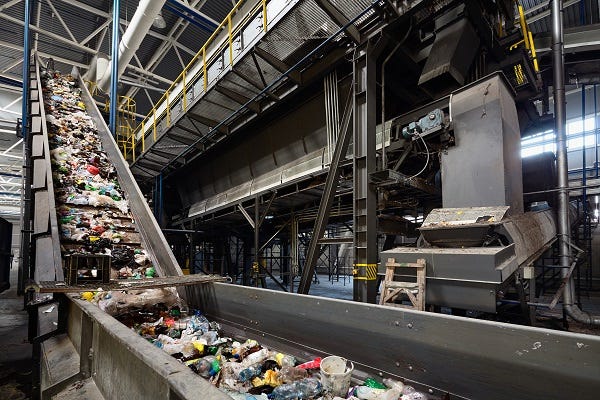
Let’s take a look at how these public and private expenditures have evolved over time… Since we have good records to estimate both public and private expenditures on cleaning shit up in London, I’ll continue to use that city as a model for examination.
In the 1860’s, London’s Metropolitan Board of Works spent roughly £4.2M pounds over 7 years under the leadership of Chief Engineer Joseph Bazalgette to modernize London’s sewers after the Great Stink of 1858. That was a massive amount of money for a public works project. In fact, Bazalgette’s sewer modernization was the single most expensive and significant project undertaken by the city of London up to that point in its history.
London’s GDP during that period is estimated at around £150M to £200M per annum (in currency value of that time). £4.2 million pounds public expenditure for the Bazalgette project would have averaged £600K per year for 7 years. That is equivalent to roughly 0.4% or 40 bps of annual GDP during the period of construction.
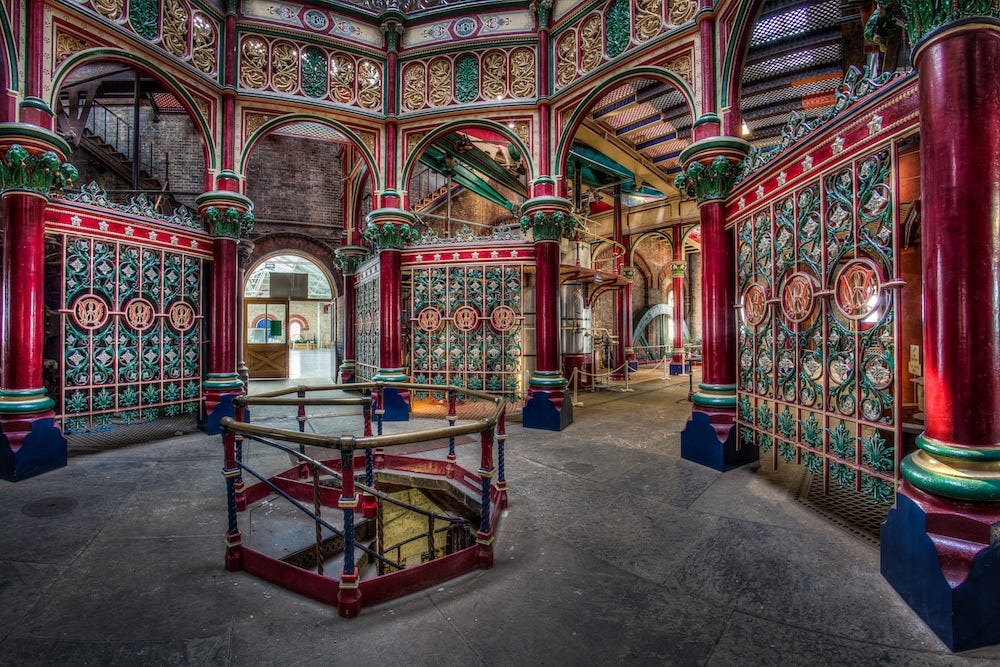
The City of London continues to extend and maintain their public sewer and sanitation infrastructure to the current day. Just this year, for example, an 8 year long Thames Tideway infrastructure project is due to complete with a price tag of over £4 billion. The city does a lot more than build tunnels for dirty water, of course. London also manages a significant Environmental Protection budget which includes waste management (recycling, collection and disposal), pollution control, as well as environmental conservation. Overall public budget for provisioning these services was around £3 billion in the 2022-2023 fiscal year.
On top of that £3B of public spending from tax revenues, private households and businesses in London also spent around another estimated £3B to £5B of their after-tax budgets for waste management services in and around their homes and offices that year. In total, London spends £6B to £8B of both public and private money each year to clean up its own shit. As a percentage of the city’s £487B GDP, that would be around 1.6%.
I find it super interesting to see how expenditures on cleaning shit up have grown from around 0.38% of city GDP in 15th century London up to over 1.6 percentage points the 21st century… Over the centuries, we have multiplied the portion of our total productivity that we spend each year on cleaning shit up off our streets by more than 4x — four times!
Ever since the 1800’s societies around the world have been ramping up the sums spent each year on cleaning shit up. Since London was the first city to implement modern sewers, it has tended to outpace the rest of the world on waste management investment. We can look at London’s spending pattern as an early-adopter forerunner example of where the rest of the world is likely headed over the long term (century) ahead. The chart, below, highlights an estimate of London’s expenditures vs. Global expenditures.
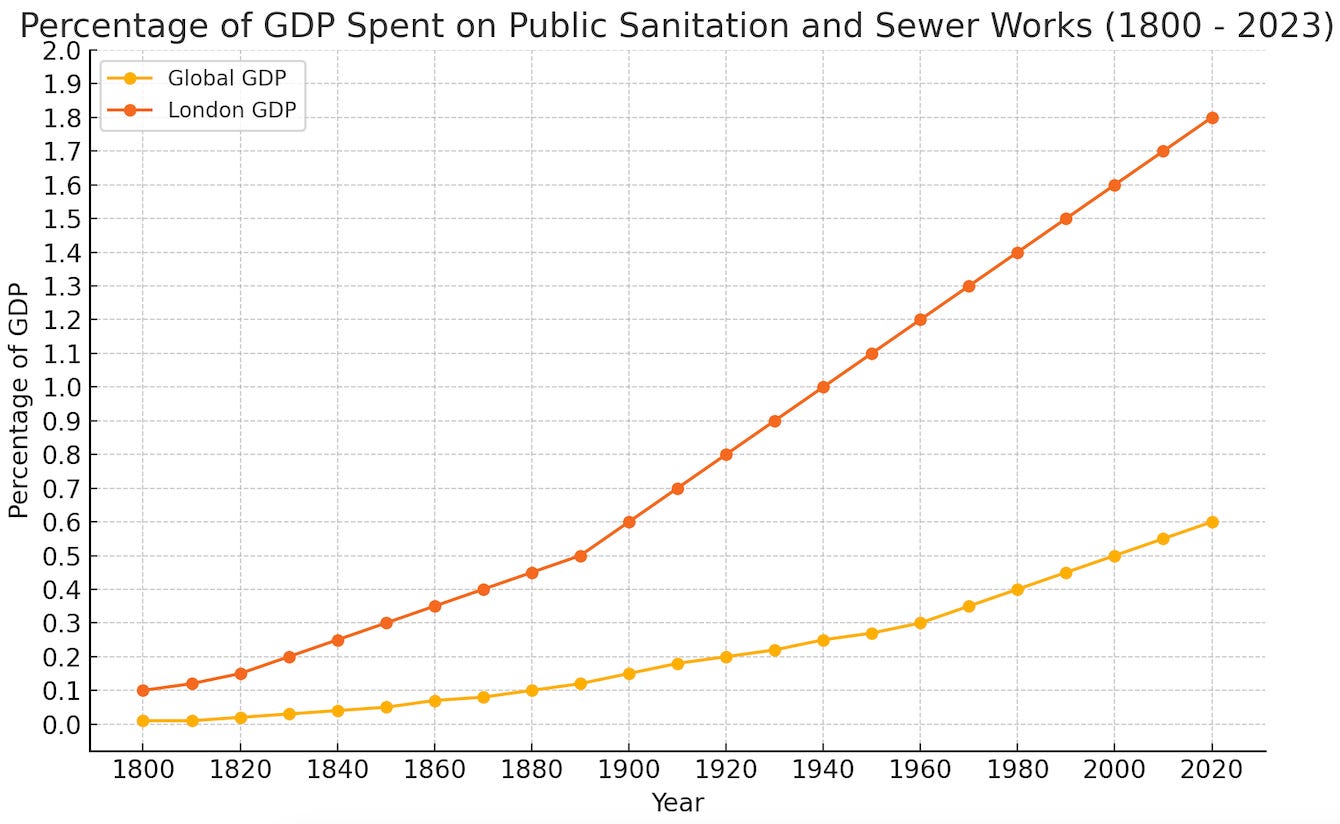
These observations are based on a handful of data points from the sanitation industry, so obviously be careful and do more research before drawing your own conclusions. We can dig up more historical data and sharpen the tenths-of-percentages here or there. But even without going through that effort, to this writer, at least, there is a clear *upward* pattern that applies to expenditures on managing all kinds of societal wastes and effluents…
Cleaning shit up may not be a glorious activity and definitely not a topic that people like to engage with around the dinner table. Nonetheless, I think it’s important for all of us to see the way human societies tend to leave shit piling up has predictably resulted in larger and larger percentages of global GDP spent on managing waste and effluents over time. This pattern will likely continue into the future and forms a central thesis of this newsletter:
Cleaning shit up is the ultimate growth industry.
As an investor, it can be difficult to predict and catch growth trends. But there is one pretty sure bet that a lot of folks aren’t paying attention to: every form of societal progress and every industrial sector creates new forms of shit that sooner or later needs to be cleaned up. The global economy is going to spend an increasing percentage of our total productivity on cleaning up all this shit. Even in a future where human societies have all successfully transitioned to 100% renewable power and regenerative, circular economies; that future would require us to literally spend half (50%) of our total global productivity on processing the shit comes out of the other half. In the meantime, there are so many interesting categories, companies and people working on cleaning shit up around the world. We’ll start to meet some of them in future installments of The New New Shit.
Before ending this post, I feel it’s important to say: even as we discuss the economic growth that is likely ahead for management of all types of societal wastes and effluents, the way our global societies and cultures make opportunities available (or not) to individuals has never been fair or equitable and still is not today. This newsletter is not explicitly focused on social justice or fair access, but these societal issues do strongly intersect with business when societies systematically hold back some genders, castes, classes, abilities, or races from fully participating in and benefiting from economic opportunities.
Study after study has verified and confirmed that businesses perform better when they operate with inclusive practices that treat all stakeholders fairly. This especially applies to the shitty businesses of the world where it is common to see societies push lower status people into the most dangerous and difficult jobs; literally closest to the shit. Dealing with all the different forms of shit piling up around the world is a balancing act of economic, political, and social dynamics. And as the scale of capital deployments for waste management continues to rise over time, urgency also increases to find balanced solutions for the shit around us.
It’s already a difficult enough challenge as it is and we, as humanity, need all of our best minds and strongest hearts working on it. Any systematic inequality in distribution of opportunities and outcomes that we impose upon each other is just hobbling all of us collectively in the long run.
That’s not bleeding heart, “woke” liberalism. It’s just straight-up rational, get-shit-done pragmatism. In fact, one could paraphrase many corporate values as well as a core tenet of all major world religions: “The world is shitty enough out there, so let’s not be shitty to each other.”
Peace out, ‘til next time. 🕊️💩